Rapid Render API

A Immediate-mode, high-performance WebGL 2D renderer for browser games.
Website | Docs | API Reference | NPM
What is Rapid?
Rapid is a focused WebGL 2D rendering engine for games and visual tools. lightweight just 69 kB (~20 kB gzipped) and handles only the rendering layer, leaving your game architecture entirely in your hands.
If you don't want your renderer to dictate how your game is organized, Rapid.js is for you!
Highlights
-
Rendering speed
An efficient batching system significantly reduces draw calls, allowing Rapid.js to maintain smooth, stable performance even when rendering large numbers of sprites at once. -
Powerful custom shaders
Add sprite and geometry effects through shader hooks while still using Rapid's normal renderer, transforms, textures, and draw APIs. -
Flexible transforms
Fast, flexible, matrix-powered transforms for motion and hierarchies. Retain the matrix tree after traversal; local changes update only affected subtrees. No rebuild required. -
A complete 2D toolkit
Draw sprites, lines, masks, particles, render textures, text, and custom geometry from one compact WebGL renderer.
Install
npm install rapid-render
Quick Start
import { Rapid, Color } from "rapid-render";
const canvas = document.querySelector("canvas")!;
const rapid = new Rapid({canvas});
const texture = await rapid.texture.load("./image/sprite.png")
rapid.clear();
rapid.drawSprite({
texture: texture,
x: 40,
y: 40,
});
rapid.flush();
Render a scene
Expressing complex game hierarchies doesn't require DisplayObject trees. rapid.matrixStack brings the familiar, intuitive save() and restore() flow from Canvas 2D into high-performance WebGL, letting you compose parent-child relationships with zero object allocation.
// root
// ├── world
// │ ├── player
// │ └── enemies
// │ ├── enemy #0
// │ ├── enemy #1
// │ └── ...
// └── ui
const stack = rapid.matrixStack;
// 1.root
stack.save();
stack.translate(0, 0);
// 2.world
stack.save();
rapid.drawSprite(player); // player
// 3.enemies
stack.save();
for (let i = 0; i < 2; i++) {
stack.translate(x, y);
rapid.drawSprite(enemies[i]); // enemy
}
stack.restore(); // 3.enemies
stack.restore(); // 2.world
stack.restore(); // 1.root
// ui
rapid.drawSprite(ui);
Reuse and Update Matrix Subtrees
rapid.matrixStack does not sacrifice the flexibility of a retained scene graph. Use customMatrix to render with any matrix in the hierarchy(even after its stack scope has been popped)
When you modify a node's local matrix, call updateMatrixSubtree() to automatically recalculate that node and all affected descendant world matrices, without rebuilding the entire matrix hierarchy.
rapid.clear();
const stack = rapid.matrixStack;
const matrix = rapid.matrix;
// Build a transform hierarchy.
const world = stack.save();
stack.translate(200, 200);
const enemyNode = stack.save();
stack.translate(80, 0);
stack.restore(); // enemyNode
stack.restore(); // world
// Both nodes have been popped, but their matrices remain available.
// Move the world node later in the same frame.
matrix.identity(world.local);
matrix.translate(world.local, 100, 100);
// Recalculate only `world` and its descendants.
stack.updateMatrixSubtree(world);
// Render using the stored matrix of the popped child node.
rapid.drawSprite({
texture: enemy,
customMatrix: enemyNode.world,
});
rapid.flush();
For more information about matrix transformations, see the Transformations.
Benchmark
Performance Comparison: Rapid vs. Other Renderers and Game Engines
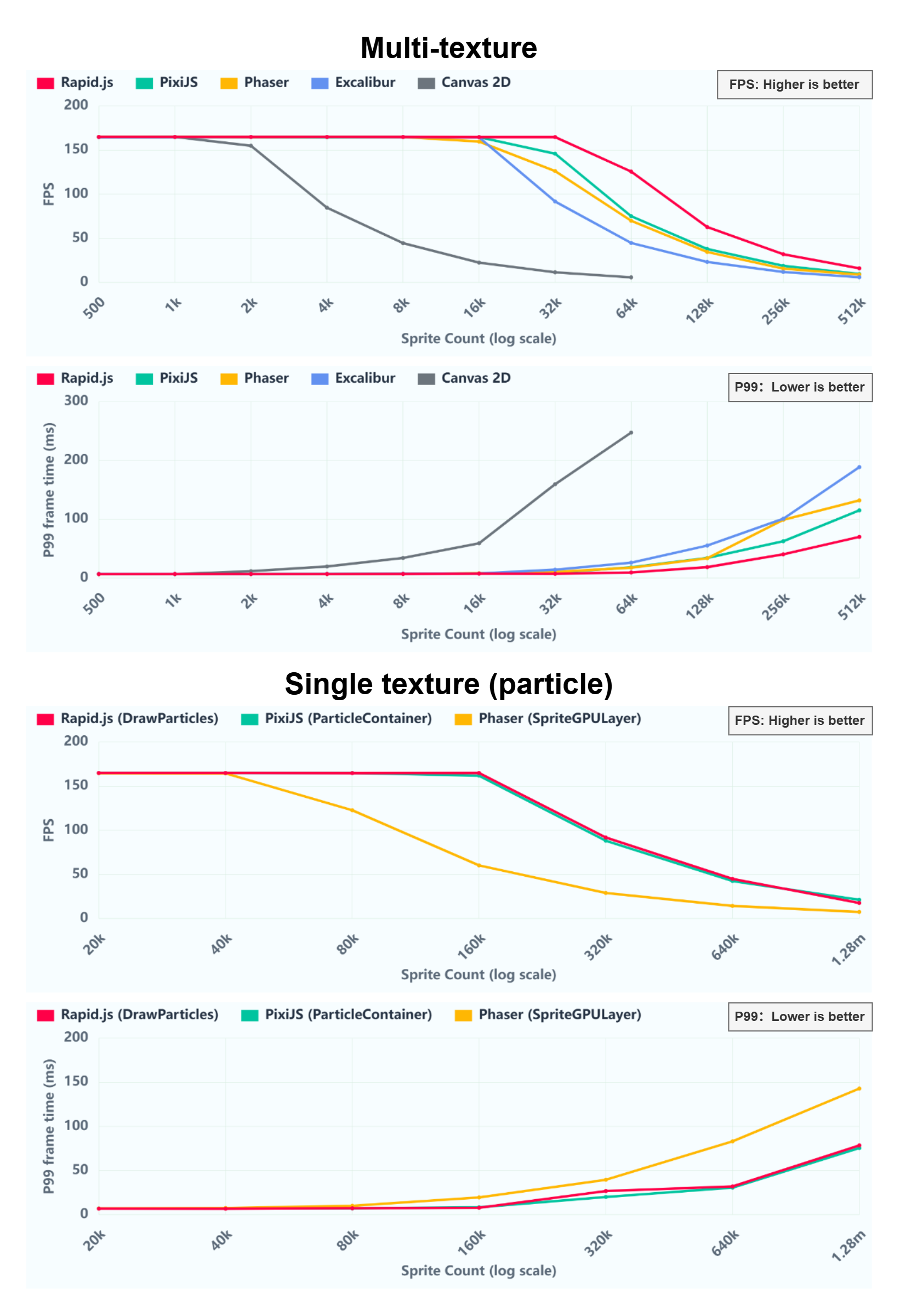
Run Interactive Benchmark Live
Tested on Windows 11 / Intel i7-12850H / NVIDIA RTX 4070 Laptop GPU / Google Chrome (WebGL 2.0)
Who is using Rapid.js?
We'd love to feature your work! Please Submit a Pull Request or tell nightscratch1145@gmail.com to add your game or app to the showcase!

|
Avoid the Zeros by Foxdog Studios Foxdog Studios used Rapid.js to deliver fast download times and smooth multi-sprite rendering for thousands of audience members playing simultaneously on their mobile phones at the Sydney Opera House. |

|
Emoji Party by illusivegames A featured puzzle hit on Poki, surpassing 6 million plays. Rapid.js powers its smooth rendering and instant-play experience across hundreds of thousands of diverse mobile and desktop browser environments. |
Contributing
Contributions, issues, and feature requests are welcome!
Before submitting a Pull Request, please ensure:
- Strict TypeScript (Zero any): All code must pass strict type checking with zero
any, loose casts, or@ts-ignoredirectives. - Passing Checks: Run
npm run buildto ensure clean compilation with zero warnings or errors.